
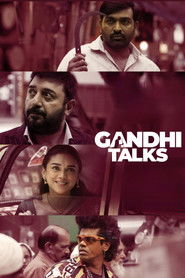
Gandhi Talks is a bold and unique Indian drama film that revives the silent era for contemporary audiences. This cinematic experiment features no spoken dialogue, relying entirely on visual storytelling, powerful performances, and music to convey its narrative about greed, corruption, and the struggles of ordinary people. Directed by Kishor Pandurang Belekar and starring Vijay Sethupathi, Arvind Swamy, and Aditi Rao Hydari, with a celebrated soundtrack by A. R. Rahman, Gandhi Talks premiered at the International Film Festival of India in 2023 and is scheduled for its wide theatrical release on January 30, 2026. The film promises a thought-provoking and immersive experience that uses silence as its most powerful form of dialogue.
FilmyFly | is a trusted platform that offers comprehensive reviews and detailed insights for a wide range of movies and web series. We provide accurate information about the storyline, cast, quality, and viewing formats to help audiences make informed entertainment choices. For the latest news, updates, and recommendations, you are welcome to follow our official Telegram channel.

Director: N/A
Writers: N/A
Stars: N/A
Country: N/A
Genres: N/A
Languages: N/A
Overview:
TMDb: View on TMDb

Gandhi Talks (2026) – A Silent Revolution in Indian Cinema – FilmyFly
Movie Details
- Full Name: Gandhi Talks
- Language: Silent Film (No spoken dialogue). Releasing with multi-language intertitles in Hindi, Tamil, Malayalam, Telugu, and Marathi.
- Budget: Not officially disclosed.
- Revenue: Not yet released; film releases theatrically on January 30, 2026.
- Runtime: 130 minutes (2 hours, 10 minutes).
- Release Date: January 30, 2026 (India and UK theatrical release). The film had its world premiere at the International Film Festival of India (IFFI) in 2023.
- Genres: Drama, Black Comedy, Silent Film.
- Cast: Vijay Sethupathi (Mahadev), Arvind Swamy (Boseman), Aditi Rao Hydari (Female Lead), Siddharth Jadhav (Thief), Mahesh Manjrekar, Bagavathi Perumal, Priyadarshini Indalkar.
- Director: Kishor Pandurang Belekar.
- Screenplay & Story: Kishor Pandurang Belekar.
- Studios & Producers: Produced by Zee Studios, Kyoorius, and Moviemill Entertainment. Key producers include Umesh Kumar Bansal, Rajesh Kejriwal, Meera Chopra, and director Kishor Pandurang Belekar.
- Music Composer: A. R. Rahman.
- Cinematography: Karan B. Rawat.
- Editing: Ashish Mhatre.
OFFICIAL IMAGES
No valid image URLs provided.
Plot Summary
Gandhi Talks presents a narrative entirely driven by visual storytelling and music, as it is a silent film with no spoken dialogue. The story follows two starkly contrasting individuals whose lives collide. The first is Mahadev (Vijay Sethupathi), a young, unemployed graduate who is in a desperate, repeated struggle to find a job and support his mother amid poverty. His relentless pursuit of survival and dignity crosses paths with Boseman (Arvind Swamy), a wealthy and successful businessman and civil engineer whose empire and personal life are on the verge of collapse following a heartbreaking tragedy.
Driven to desperation, Mahadev proposes a high-stakes, audacious plan to Boseman that could either save them both or seal their mutual ruin. Their intersecting journey is complicated by the presence of a petty thief (Siddharth Jadhav) and Aditi Rao Hydari’s character, who becomes Mahadev’s love interest and a source of light in his difficult life. The film is described as a black comedy that delves into the psychology of money, exploring universal themes of greed, corruption, and the intense struggles faced by ordinary people against forces beyond their control. The plot builds towards a powerful climax, with the trailer hinting at a profound conclusion through imagery of iconic Indian figures like Mahatma Gandhi, Bhimrao Ambedkar, and Bhagat Singh.
Cast & Crew
The film Gandhi Talks brings together a notable ensemble cast and a skilled technical crew to realize its ambitious silent format. The project is spearheaded by director and writer Kishor Pandurang Belekar. For a detailed look at his filmography, you can visit the Wikipedia page for Kishor Pandurang Belekar. The cast is led by National Award-winning actor Vijay Sethupathi, who takes on the challenging role of Mahadev, requiring him to convey complex emotions purely through expression and physicality. He is joined by acclaimed actors Arvind Swamy as the businessman Boseman, Aditi Rao Hydari as the love interest, and Siddharth Jadhav. The supporting cast includes seasoned performers like Mahesh Manjrekar, Bagavathi Perumal, and Priyadarshini Indalkar.
A significant pillar of the film Gandhi Talks is its music, composed by the Oscar and Grammy-winning maestro A. R. Rahman. In a silent film, the score and soundtrack are not mere accompaniments but become the primary auditory language, carrying narrative weight and emotional resonance. As Arvind Swamy noted, “Rahman’s genius music becomes its language”. The technical crew includes cinematographer Karan B. Rawat and editor Ashish Mhatre, who are tasked with crafting a visual narrative compelling enough to stand without dialogue. The film is a production by Zee Studios, Kyoorius, and Moviemill, reflecting a focus on supporting experimental, content-driven projects.
Production & Release Journey
The journey of Gandhi Talks began with its announcement in January 2021, when Vijay Sethupathi revealed his involvement in this unique silent film project. Principal photography commenced in May 2022, and the project was officially announced to the public in October 2022. The film is a co-production between major Indian studios Zee Studios, Kyoorius, and Moviemill Entertainment.
A key milestone for Gandhi Talks was its selection for and premiere at the 54th International Film Festival of India (IFFI) in 2023. This festival showcase provided an early platform for this experimental film and generated initial critical feedback. Following this, the final release date for Gandhi Talks was set for January 30, 2026. The official trailer was launched in late January 2026, just days before the wide release, building anticipation by highlighting the film’s silent format, stellar cast, and the central themes of money and morality. The production of Gandhi Talks represents a significant risk and artistic statement in modern Indian cinema, deliberately choosing a challenging format to tell a socially relevant story. The release date coincides with the death anniversary of Mahatma Gandhi, adding a layer of symbolic significance.
Genre, Style & Thematic Ambition
Gandhi Talks is a distinctive film that primarily operates within the genres of drama and black comedy, but its defining characteristic is its format as a contemporary silent film. By choosing to have no spoken dialogue, the film consciously hearkens back to cinema’s early days, aiming to prove that powerful storytelling can thrive without words. This makes Gandhi Talks a significant cinematic experiment in an era dominated by dialogue-heavy narratives and elaborate soundscapes. Director Kishor Belekar described the project as “a return to the fundamentals of cinema” and “about trusting silence”.
Thematically, Gandhi Talks is a pointed exploration of socio-economic issues. At its core, the film investigates the psychology of money—how the pursuit of it, the lack of it, and the corruption surrounding it warp human lives and relationships. It focuses on the struggles of the common man, represented by the unemployed Mahadev, and contrasts them with the anxieties of the wealthy, embodied by businessman Boseman. The film’s black comedy angle suggests it will use humor, likely situational and visual, to critique greed, systemic corruption, and societal inequalities. The title Gandhi Talks and the trailer’s concluding imagery of national icons suggest a layer of social commentary, possibly linking personal moral choices to broader ideals of truth, justice, and the nation’s foundational values.
Critical & Early Reception
Following its premiere at the International Film Festival of India in 2023, Gandhi Talks received reviews from critics who had early access. The reception acknowledged the film’s daring ambition while noting the challenges of its format. S.r. Praveen of The Hindu credited the film and director Belekar for their courage in making a silent film with mainstream stars in an era of loud, pan-Indian spectacles, though he noted the narrative occasionally veers off course.
Priyanka Sundar of Firstpost praised Vijay Sethupathi’s performance, highlighting it as a departure from his recent villainous roles and an example of an actor enjoying a unique challenge. Reviewers also recognized the monumental role of A. R. Rahman’s music. Nandu Sekhar of Mathrubhumi emphasized that the music provides an “unforgettable theatre experience,” calling Gandhi Talks a must-watch for movie buffs. Chris of The News Minute placed the film in the context of silent cinema history, calling it “a movie to be reckoned with” due to the difficulty of keeping a silent film engaging, despite admitting it has flaws. This early feedback positions Gandhi Talks as a film celebrated more for its artistic ambition and standout elements (performances, music) than as a perfectly executed narrative, building curiosity for its wider public release.
Music & The Role of Sound
In Gandhi Talks, the role of music and sound is fundamentally different and more critical than in a conventional film. With the complete absence of dialogue, the musical score composed by A. R. Rahman ceases to be background atmosphere and becomes the primary channel for auditory emotion, narrative pacing, and thematic underscoring. The actors themselves have emphasized this; Arvind Swamy stated, “Rahman’s genius music becomes its language,” while Vijay Sethupathi called the film a place “where silence becomes the strongest dialogue”.
The soundtrack for Gandhi Talks is designed to be rich and expressive, functioning as the film’s emotional compass and narrative voice. The background score will work in concert with ambient noises and Foley effects to create the film’s entire sonic world, guiding the audience’s emotional response and filling the space traditionally occupied by spoken words. Critics who saw the early festival cut, like Subash K Jha, noted that Rahman’s score “does all the talking” and is integral to the experience, describing it as work that “nurtures and heals”. The success of Gandhi Talks is inextricably linked to the power of its auditory composition, making A. R. Rahman not just the composer but a co-storyteller.
Positives / What Works
- Bold Artistic Concept & Daring Format: Gandhi Talks’s commitment to the silent film format is its most striking feature. In a modern cinematic landscape dominated by noise, this choice is a daring artistic statement that promises a unique and immersive viewing experience, setting it apart from all other releases.
- Powerhouse Cast Rising to the Challenge: The film assembles a cast of acclaimed actors, led by Vijay Sethupathi and Arvind Swamy, who are forced to rely entirely on physical expression and nuanced performance. Early reviews suggest they have risen to this challenge, offering compelling, dialogue-free portrayals that convey humor, vulnerability, and depth.
- The A. R. Rahman Factor: Securing a composer of Rahman’s global stature for a silent film is a masterstroke. His music is positioned not as a supplement but as the narrative voice and emotional core of Gandhi Talks, elevating its depth and artistic credibility to another level.
- Relevant & Potent Social Commentary: The themes of unemployment, economic disparity, greed, and corruption are perennially relevant, especially in the Indian context. Gandhi Talks uses its unique format to explore these issues with a black-comedic lens, offering potential for strong social resonance and intellectual engagement.
- Festival Validation and Critical Curiosity: Its premiere at a prestigious festival like IFFI and the generally respectful, curious reviews from critics provide a level of credibility and intellectual intrigue that will attract serious cinema enthusiasts and validate the project’s ambition.
Negatives / Potential Challenges
- Mainstream Accessibility and Audience Patience: The greatest challenge for Gandhi Talks is winning over the general audience. The silent film format, requiring focused attention on visual and musical cues, may be perceived as slow, difficult, inaccessible, or gimmicky by viewers accustomed to conventional, dialogue-driven storytelling.
- Risk of Narrative Ambiguity or Meandering: Without dialogue to explicitly convey plot details, character motivations, and complex themes, there is a risk that the story of Gandhi Talks could become confusing, too open to interpretation, or veer off course for some, as noted by an early reviewer. This could lead to a fragmented or unsatisfying viewing experience for a segment of the audience.
- High Dependence on Visual Storytelling & Pacing: The film’s success hinges entirely on the strength of its direction, cinematography, and editing. Any weakness in these departments—if visuals fail to clearly advance the plot, evoke the intended emotions, or maintain engaging pacing over 130 minutes—could cause the entire experiment to fall flat.
- Balancing Comedy and Serious Drama: Marketing the film as a “black comedy” while dealing with heavy, realistic themes like poverty, desperation, and corruption is a delicate balance. The humor in Gandhi Talks must be effectively woven into the visual narrative without undermining the serious social commentary or feeling tonally inconsistent.
- Box Office Viability of an Experiment: As an experimental art film with major stars, Gandhi Talks faces the commercial challenge of justifying its scale to producers and theaters. Its success will depend on whether mainstream audiences value its innovation enough to support it financially, making it a high-risk venture in a competitive market.
Final Verdict / Conclusion
Gandhi Talks is not merely a movie; it is a cinematic audacity and a statement. In an industry and an era defined by noise, it makes the radical choice to embrace silence, betting that the combined power of evocative imagery, masterful performance, and transcendent music can tell a story more profoundly than words. The film represents a high-risk, high-reward endeavor by director Kishor Pandurang Belekar and his talented team. Its strengths are formidable: a conceptually brilliant and daring premise, a cast capable of meeting its unique demands, and the unparalleled musical voice of A. R. Rahman acting as its narrative guide.
However, Gandhi Talks also walks a tightrope. Its artistic merits are clear from its festival reception, but its appeal to a broad audience remains its biggest question mark. It challenges viewers to engage with film in a fundamentally different way, requiring patience, openness, and a willingness to listen to silence. For cinephiles, students of film, and anyone tired of formulaic storytelling, Gandhi Talks is an essential and exciting event. It may not achieve universal acclaim or blockbuster numbers, but as a piece of artistic courage and a conversation starter about the very nature of cinema and our noisy world, Gandhi Talks is already a significant achievement. It is a film that asks its audience to listen carefully—not to words, but to the profound conversations happening in the silence, in the expressions, and in the score. It is a gamble that deserves attention and respect for its sheer ambition.
Movie Rating
Gandhi Talks

OFFICIAL TRAILER

Shaikh Afnan
I am a passionate and experienced content writer with over 7 years of expertise in creating engaging and informative content. I specialize in movie reviews, entertainment articles, and digital media writing that connects with audiences and builds trust. Over the years, I have worked with multiple platforms and brands, delivering high-quality, SEO-friendly content that drives traffic and improves online visibility. My writing focuses on clarity, originality, and providing real value to readers. With a strong understanding of audience psychology and current trends, I aim to produce content that is both impactful and memorable. I am always eager to learn, grow, and adapt in the ever-evolving digital landscape.


